Skip to content
All books
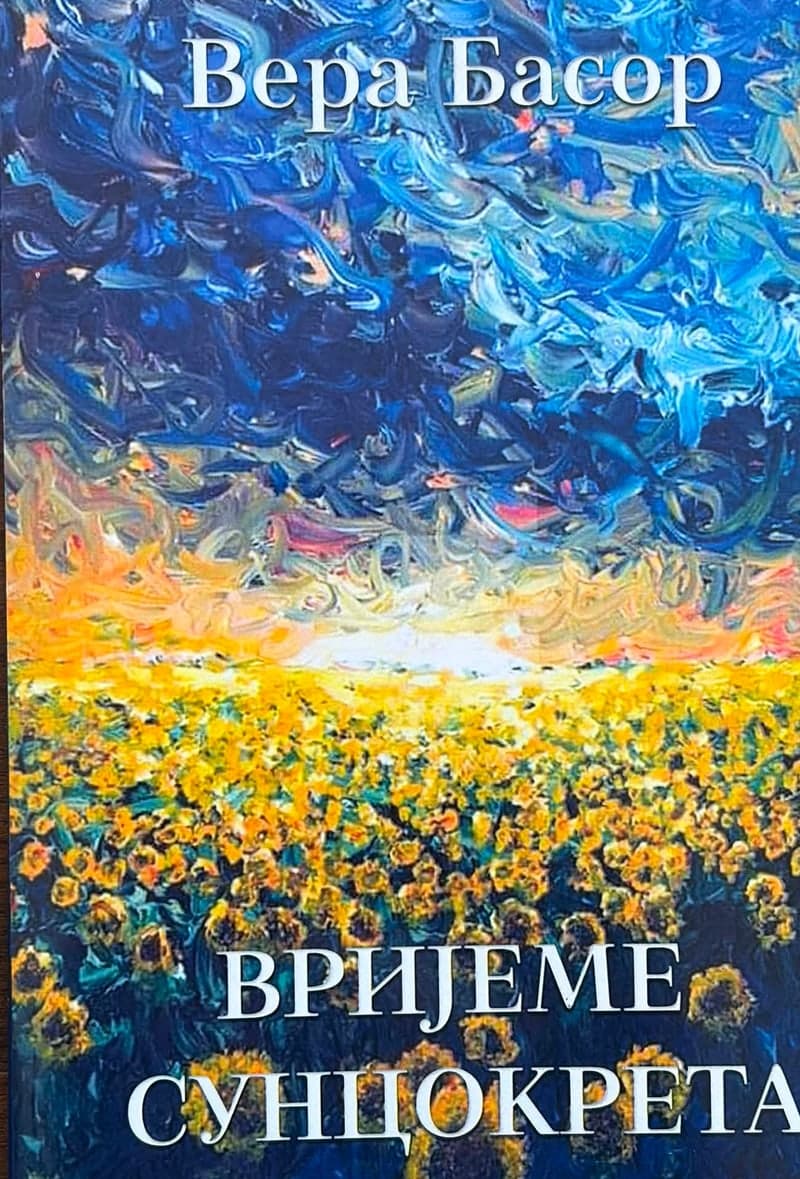
Time of Sunflowers

Time of Sunflowers

ASoglas, Zvornik i Narodna biblioteka Trebinje · 2023

A collection in which the landscapes of her native Trebinje are woven into higher, cosmic heights. Through the image of sunflowers turned toward one another, the poet intimates an idea of togetherness, love, and gratitude, and offers a distinctly Christian sense of life. Poetry as prayer, and as a search for the blue, for the sun’s dust and the moon’s sonata.

Where to find it

You can also ask for it at your local library.

Poems from this collection

A Flower

Last night the stars wove themselves into my sister’s hair. I knew it was her; I dreamed of the Trebišnjica. I watch from Leotar, and she, in all her stature, winds through the capital, for centuries.. Clear and bright, dark green, like my sister’s eyes. Mine are distant and restless; quiet and wise, the eternities of my childhood. A relentless tear rises from the ashes; it hurts the more the more one dreams, with a tear the stone is kissed, and from it the loveliest flower breaks forth.

Mother

Night. In my hometown the shadows flutter. As once the sky burns with dusk and fiercely longs to buy back time. The evening smells of incense, and words are washed with peace, a warm whisper from the icon of my dear Three-Handed Mother, the little Mother of Ljeviška. Do not ask me, my dear, how long time lasts, or what stirs in the depths of my universe; all is lonely and restless in the soul. The heart is such: it does not speak, yet breathes; a small flame that flares, kindling into fire. Who but a mother calls me so, through night and tears blessing me endlessly, without fear, from a distant stone, without a tear, without a name.

Sunflower

Turned toward one another, in all of time. Our souls are made of the energy of light, pure and radiant, stronger together. We last longer and shine brighter through every darkness and every evil age. Like sunflowers that lean toward the light of the sun and at evening bow their heads toward one another, in a whisper.. through the long night they give each other the light of the sun.

Reviews

The broken rules of life and conduct, each bearing the seal of individual destinies, are framed by the whisper of a soul whose strength of longing to step beyond it all stands as the seal of these lyric notes. This intriguing collection, with its collage-like confessional tone that seeks to defeat the ugly side of the everyday, carries within it the poet’s pronounced subjectivity. Intimacy, in the broader sense, is spread before the reader like a many-coloured fan of belief in what must have worth in order to endure and remain in a world full of heart and faith: a longing for an ordinary warm word that must hold the power of magic (that one is not alone), a faith in the enchantments kept as the nourishment of a guarded childhood and of dear ones. The “scents of the warm sky” have vanished; the wish is hidden in rainbow colours so the secret washed by raindrops may be recognized, and a great hope for new whispers inscribed in the prayer book of celebration. Across a varied, almost fairy-tale range of themes, Vera Basor shows a mature poetic voice suited to her sensibility. The style is accomplished, the verse fluent, and it is a pleasure to enjoy this gift of hers to readers.
Đorđe Dabarčić
Lyrically awakened to the finest nuances of life’s and the cosmos’s interweavings, to quiet (spiritual) joys and metaphysical intimations of the transience and frailty of all that is visible and tangible, the author offers the reader, in “Time of Sunflowers”, above all a distinctly Christian sense of life, from which feelings of love and gratitude arise. At the same time, she suggests an idea of togetherness (in the image of sunflowers and their turning toward one another) as a principle the modern world denies, yet in which dwells all the meaning of existence and all the potential for the survival of the human being on earth.
Marija Jeftimijević Mihajlović
Vera Basor’s collection “Time of Sunflowers” reflects a search for selfhood through a poeticized remembrance of people and occasions, while also immersing itself in the world within and around her. By testing the limits of expression, these verses bring tremors of the otherworldly and the eternal through the sensed and the lived. Descriptions of her native city are given with an allusion to the “Eternal Nomad,” and the city below Leotar is presented as part of the harmonious whole of God’s creation: images of Trebinje are woven into a higher landscape of cosmic heights. Poetry as a search for the blue, for the heights, for the boundless, for the sun’s dust, for the moon’s sonata. The collection has two lines, two levels of poetic expression: one real, the other symbolic. Poems dedicated to Saint Basil of Tvrdoš and Ostrog, to Dučić, Njegoš, Bishop Atanasije, to her mother, and the poetic note about Vera’s late friend Dragana Vujičić, “whose soul dreams in eternity,” are given in a prayerful register. Familiar prayers drift through Vera’s verses. Prayer gives this collection an expression of universality and closeness. Vera managed both to write an ode to her native city and to portray the inner pilgrimage of the soul.
Milana Babić

    This site uses privacy-friendly analytics to understand what readers enjoy. No ads, no tracking across sites.