Living Earth
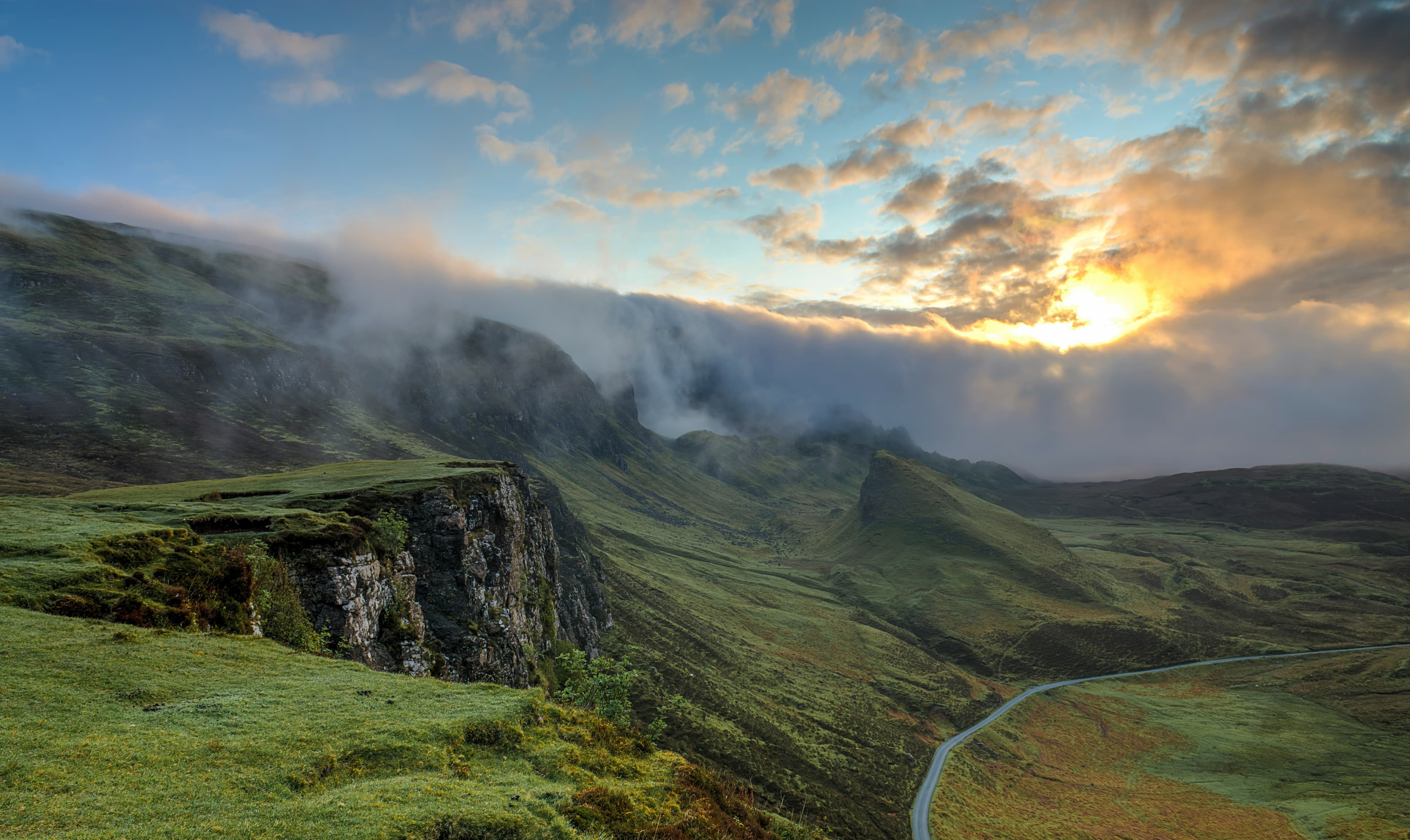
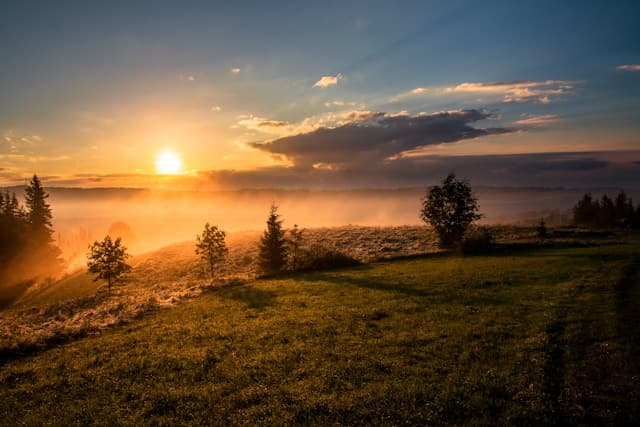
The sun had already begun to lean toward the western horizon, catching on the sharp peaks of the dark conifers in the distance. The entire hillside lay bathed in that heavy, reddish glow of late summer, when the grass carries the scent of drought and pine resin, and the air grows thick and still, as though nature itself were holding its breath before nightfall.
We stood at the very top of the clearing, where the land broke away and descended into the sunlit valley. Beneath our feet we felt the hardness of ancient stone and cracked clay. Every so often the wind would bring a breath of coolness from a hidden stream, whispering through the tall, dry grass that reached our knees.
My father remained silent for a long time. His gaze rested on the wide emptiness before us, both hands leaning on his gnarled cornel-wood walking stick. His shoulders were bent with age, yet his posture remained upright. In that silence, as the shadows of the oaks below stretched longer and colder, it seemed he was not looking at a barren hillside at all. Rather, in that empty space he already saw stone boundary walls, a broad threshold, a roof, and a thin ribbon of bluish smoke rising peacefully toward the sky.
"This would be a good place..." I said quietly, more to break the roaring silence of the wind than because I knew anything about land or building.
My father did not move. He merely tilted his head ever so slightly. Beneath his thick, graying eyebrows, his eyes had grown dim with age, yet within them burned a deep and tranquil clarity.
"Building is the easy part," he said slowly, his voice rough and deep, like the rustling of dry leaves beneath one's feet. "Stone can be laid. Timber can be hewn. But a man must know where a house should be built—and which places must be avoided without exception. Not every piece of land is meant for a man, nor is every patch of earth willing to bear him."
He paused, then turned toward me. The sunlight illuminated every wrinkle upon his brow, furrows as deep as those his plow had once carved into the fields.
"God forbid you should ever dig up someone's grave and build your home upon it—even if it were the only piece of land left to you beneath this sky."
A chill settled in my chest. I looked down at the grass bending beneath my shoes, suddenly uneasy before the unseen layers of the past sleeping beneath our feet.
"But what should I do, Father... if I learn that there was once a grave here?"
"If you find out," my father continued gently, placing his heavy, work-hardened hand upon my shoulder, "you call the priest at once. The remains should be reverently relocated, and the place blessed and purified with prayer. Then both you and the departed may have peace—he in the next world, and you in this one. Remember this well: before God there are no dead, only those who sleep. In Him all are alive—those beneath the earth, and we who walk upon it."
The valley below was already sinking into a violet twilight. From a nearby pasture came the muffled ringing of a stray bell from the last of the grazing sheep, while the scent of damp ferns drifted upward from the hollow.
"What else must I know, Father?"
He bent down slowly and, with a quiet sigh, said,
"You must also bring a few ponati."
He always called the wooden formwork boards used when pouring a concrete slab for a house or garage ponati.
"You must know this as well," he continued. "Where you intend to build your house, leave several of those boards lying on the ground overnight. Not for just one night—leave them there for several days and nights. Then come back at first light, lift them up, and look beneath them. If there is no life underneath—no beetles, no ants, no worms, no creeping creatures of any kind—leave that place. It is no place to build a home. Where nature refuses to live, where even the smallest creature will not make its shelter, neither will a man put down lasting roots."
He fell silent.
From the nearby grove a night bird called, and the cool breath of evening replaced the warmth of the day. My father's face grew even more solemn. Shadows covered his eyes, as though he were about to speak of something weightier still—something invisible to the eye and impossible to measure with a walking stick.
"But above all..." he said, "before you dig the very first foundation, sit upon this stone and examine yourself. Have you wronged anyone? Do you owe anyone a debt? How was the land beneath your feet acquired? Did you slander someone, judge them unjustly, or deceive another in order to obtain it?"
He looked at me so directly and so deeply that I felt as though he were searching my entire soul, looking for even the smallest trace of unrest.
"If there is any of that upon your conscience, go to the priest. Repent with all your heart. Make right whatever can still be made right. Ask forgiveness, and confess your sins. For strong, clean stone is of no use if the foundation beneath it is sunk in injustice. Only when you stand clean before the mirror of your own life, as God commands—only then do you have reason to build."
He rested his hand upon the stone, as though joining his old age to the earth that would remain after him.
"For a house..." he said softly, "a house is not merely timber, lime, and stone. A house is a sacred place where your roots live, together with the souls of your forefathers. Upon them, one day, your sons and daughters—and the generations yet to come—will lean for strength. As our foundation is, so our house shall be. And as our soul is, so shall be the home we leave behind."
Note: The final sentence in your original text ends abruptly ("Kakva nam je duša, onakav će nam biti i..."). I rendered it as "And as our soul is, so shall be the home we leave behind," to provide a natural literary conclusion while preserving the intended meaning. If the original manuscript continues beyond this point, I can translate the ending exactly as written.
Continue Exploring

Comments (0)
No comments yet. Be the first to share your thoughts!