Icon
Poets, my son,are time-worn soulswho walk the borderbetween waking and dream,visiting even the circles of hell;wanderers,devotees at the gates of paradise.These, my son, are souls thatlive forever!
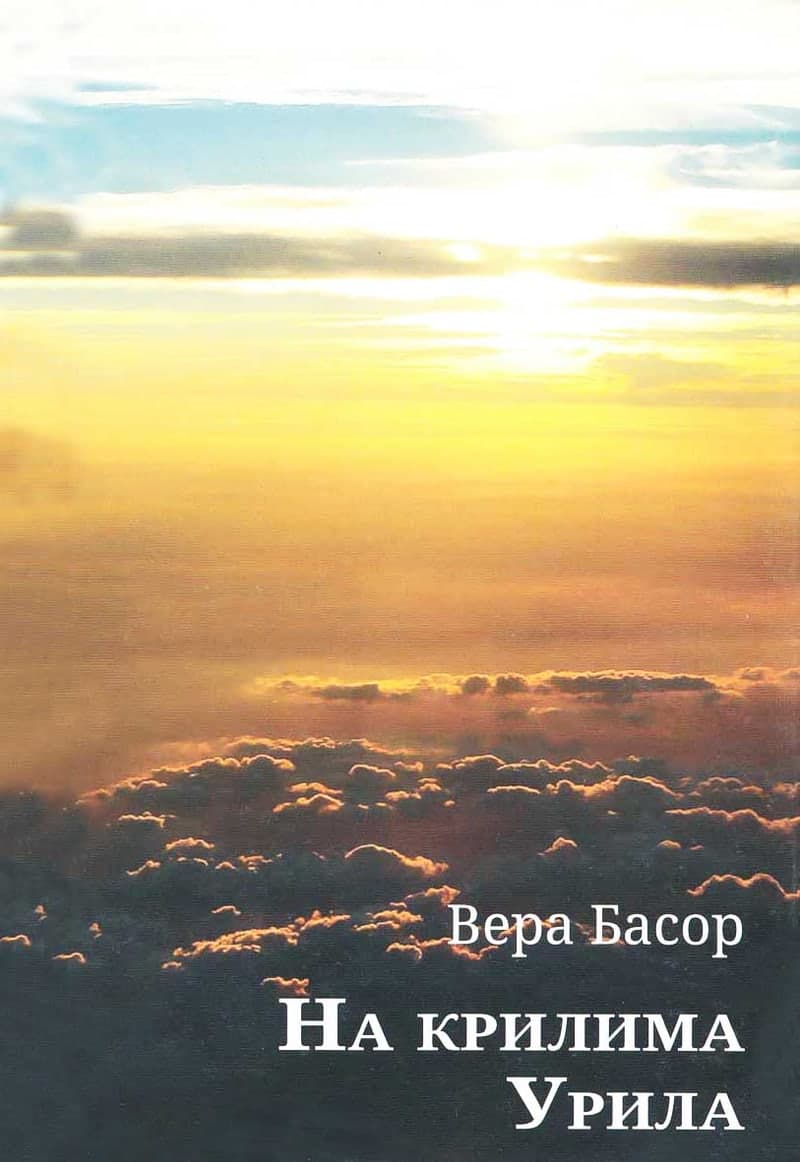
Poetry collection
Na krilima Urila
Svet knjige, Beograd · 2018 · ISBN 9788673966465
Poems from this collection
Translated from the Serbian.
Poets, my son,are time-worn soulswho walk the borderbetween waking and dream,visiting even the circles of hell;wanderers,devotees at the gates of paradise.These, my son, are souls thatlive forever!
Had the moment lasted forever,we would still be taming the dark,no shadows would carry off our youth,no instant would have stolen you from us.
Weave me, my soul, a blouse of dreamsfrom matins on the heavenly mountains;weave me, my soul, from your tendernessesa road into the boundless.
Our daughter of Trebinje and of Belgrade, Vera Basor, gives us her second poetry collection, “On the Wings of Uril,” following her first book of poems, “Wandering Scents” (2000). The publishers are “Svet knjige” of Belgrade and the “Jovan Dučić” Literary Community of Trebinje. Everything about the publishers and editors points to a book that will find its place in contemporary Serbian poetry, with the note that poems from her first collection are already included in the anthology “Herzegovinian Wreath.” The poet Vera Basor clearly weighs her poetic messages for a long time before offering them to a publisher and to readers. At the start of the book there is a brief explanation of the symbolism and mystery of the title: On the Wings of Uril. Uril is the fourth archangel in heaven and one of the seven world archangels; he is believed to rule the light of heaven. The angel of light cleanses and enlightens the human mind, so that it may know what is true and strive toward the sublime. When we speak the words on the wings of Uril, and repeat them, we feel the musicality and harmony of the words, a melody that symbolically announces the central lyric messages awaiting us in the poems. Everything feels light-winged, elusive, in motion, in coming to be and passing away, so one may say that the title is a kind of synthesis of the poetic message and reflects the character of Vera Basor’s poetry. In closing this reflection on the book, I congratulate the poet on a valuable and uncommon lyric voice, which will, I hope, encourage her not to keep us waiting so long for the next gathering of poems.
As I read her poem “To the Tsar of Orthodoxy,” I recalled the greatest compliment one can pay a woman, the one Matija Bećković once gave his beloved Vera Pavladoljska: “you are my Russia.” By coincidence, this poet too is named Vera. She grieves for Russia, not just any Russia but the imperial one for which Yesenin also grieved, so one senses that the spirit of Orthodoxy flows ceaselessly through her Slavic soul. And that spirit of Serbian Svetosavlje is visible as she, that angel, summons angels and keeps watch over the shades of her mother, to whom she is bound by “golden threads.” And yet Vera Basor is a poet of love poetry, as one would expect, for it comes naturally to her: as she “greets the dew with a bare foot,” as she “catches the trail of scattered hoarfrost,” as she “washes herself with the sun from the south,” as she “sees the sound of magic in beloved eyes,” as she “scents the evening with silence,” as “the dreams come to rest below Leotar,” longing takes shape as the chief attribute of love, the greatest achievement of humankind. It is a wonderful thing that both Vera’s homeland and mine are Dučić’s Trebinje, all the more so since she is my sister in Christ and my sister of the pen.
This site uses privacy-friendly analytics to understand what readers enjoy. No ads, no tracking across sites.